
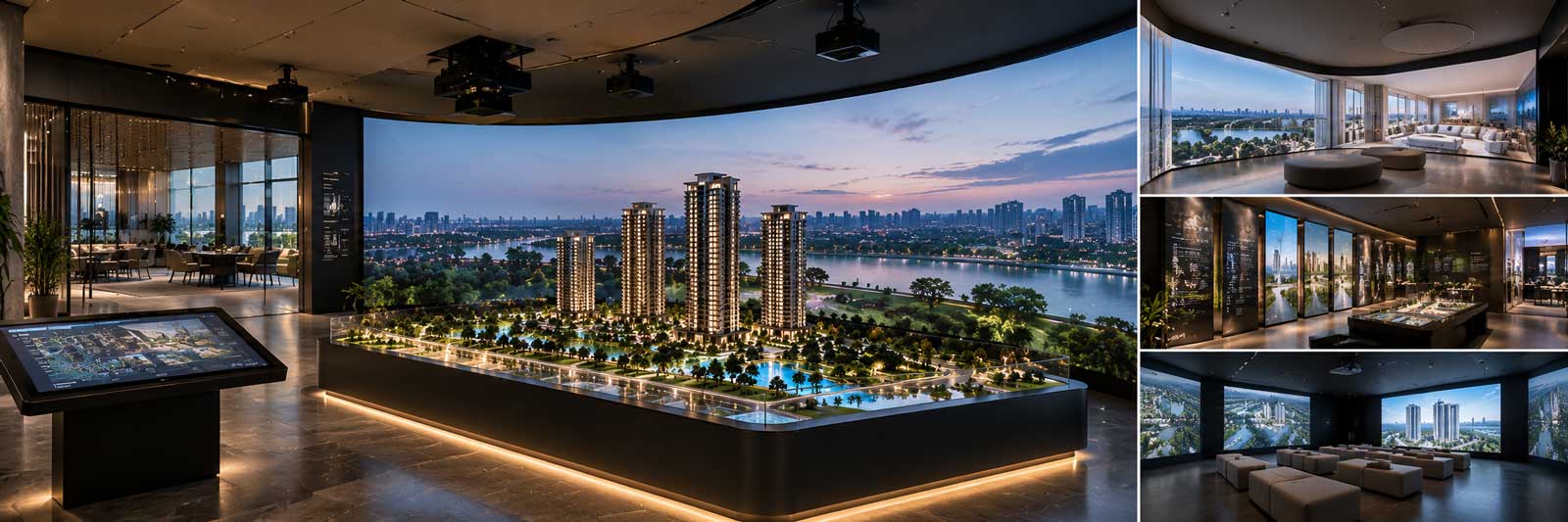
For Tier 1 real estate developers, the challenge is no longer simply presenting a property. It is about creating a high-impact experience that communicates scale, lifestyle and future value before the development is fully realised.
As premium real estate becomes increasingly experience-led, traditional sales tools such as scale models, brochures, walkthrough videos and static visualisations are being complemented by immersive technologies.One of the most compelling developments in this space is the Mixed Reality Immersive Experience Room, a multisensory environment that enables prospective buyers, investors and stakeholders to virtually experience a development through panoramic visuals, simulated movement, spatial audio and environmental effects.
For large townships, luxury developments and destination-led projects, this can transform the conventional sales centre into an immersive decision-making environment.
What Is a Mixed Reality Immersive Experience Room?
A Mixed Reality Immersive Experience Room is a purpose-built environment designed to simulate the experience of moving through a real-world property or development.
The setup can combine:
- Curved panoramic projection screens
- High-resolution immersive visualisation
- A stationary experiential buggy
- Dynamic motion simulation
- Surround and spatial audio
- Controlled airflow
- Fragrance diffusion
- Climate-controlled interiors
- Digitally created project environments
Instead of viewing a development from the outside, visitors are placed inside an experiential journey.
They can virtually travel through project roads, experience the scale of the master plan, explore landscapes and navigate different areas of the development—all within the controlled environment of a premium sales centre.
Why Immersive Technology Matters to Tier 1 Developers
For large developers, scale is both an asset and a communication challenge.
A township spanning hundreds of acres cannot always be adequately communicated through a physical model or conventional screen. Architectural renders can demonstrate individual spaces, but they may not effectively communicate how the entire development feels as an environment.
Immersive technology addresses this gap.
It allows developers to translate complex master plans into an experience that decision makers and buyers can understand intuitively.
Instead of asking a prospective buyer to interpret:
“This is where the residential zone connects to the commercial district and landscaped boulevard.” The experience can simply take them through that journey.
This can be particularly valuable when marketing developments that are:
- Large-scale
- Still under construction
- Located across extensive sites
- Lifestyle-led
- Premium or luxury positioned
- Built around complex master plans
From Property Visualisation to Spatial Storytelling
Real estate visualisation traditionally answers one question:
“What will this property look like?”
Immersive experience design can answer a much broader set of questions:
“What will it feel like to move through this development?”
A buyer can be taken through a carefully designed sequence—from entering the development to travelling along its internal roads, passing landscaped spaces, approaching residential clusters and discovering key amenities.
This transforms the master plan into a spatial narrative.
For developers, that creates an opportunity to communicate not just architecture but placemaking, lifestyle and the larger vision behind the development.
The Role of the Experiential Buggy
A stationary experiential buggy becomes the physical anchor of the immersive environment.
The visitor sits inside the vehicle while the surrounding panoramic environment creates the perception of movement.
As the digital journey progresses, the experience can simulate:
- Driving through project roads
- Approaching key development zones
- Navigating curves and turns
- Moving through landscaped environments
- Travelling towards amenities
Experiencing different stages of the development journey
The physical vehicle remains stationary, while the visual and sensory environment creates the perception of movement.
For a sales centre, this offers an important advantage: a large physical development can be experienced without requiring the visitor to physically travel across the site.
Making Real Estate Multisensory
Premium real estate is fundamentally about more than square footage and specifications.
It is about lifestyle, atmosphere and aspiration.
A mixed reality environment can reinforce that proposition by engaging multiple senses.
Visual
Panoramic projection can recreate landscapes, architecture, roads, amenities and surrounding environments.
Auditory
Spatial and ambient sound can help establish the atmosphere of different locations within the development.
Environmental
Controlled airflow and fragrance can introduce subtle environmental cues that support the experience.
Physical
The experiential buggy and motion simulation can reinforce the sensation of movement.
Together, these elements create a more complete multisensory real estate experience.
The technology becomes particularly powerful when these elements are integrated into a single narrative rather than treated as individual attractions.
A New Role for the Real Estate Sales Centre
For Tier 1 developers, a sales centre is increasingly becoming an extension of the brand.
It is no longer simply a place where sales teams explain floor plans and pricing.
It can function as:
Brand experience centre + project showcase + investor presentation environment + sales conversion space.
An immersive experience room can become the centrepiece of that environment.
A prospective buyer can first understand the project through a master plan, then explore architectural models or digital interfaces, and finally enter an immersive environment that demonstrates the scale and lifestyle proposition.
This creates a more structured journey from information to experience.
Particularly Valuable for Large-Scale Developments
The larger and more complex the development, the greater the potential value of immersive presentation.
Consider a large integrated township with residential towers, villas, retail districts, landscaped zones, entertainment areas, schools and extensive internal infrastructure.
A conventional presentation may require several different communication tools to explain these components.
An immersive environment can connect them into one continuous journey.
The visitor can understand not just individual assets, but how the entire development operates as a destination.
This is particularly relevant for developers selling a long-term vision rather than simply an individual apartment.
Beyond Buyer Engagement
- The applications extend beyond residential sales.
- A well-designed immersive environment can support:
- Investor presentations
- Pre-launch experiences
- VIP buyer previews
- International buyer presentations
- Channel partner engagement
- Project launch events
- Sales team demonstrations
- Hospitality and destination developments
- Large township presentations
- Corporate and stakeholder showcases
For developers operating across multiple markets, the experience can also become a scalable presentation asset that communicates a project’s vision consistently.
Designing for Decision-Makers, Not Just Visitors
For a premium real estate brand, immersive technology should not become a technology demonstration for its own sake.
The experience needs to serve a commercial objective.
The most effective immersive sales environments are built around three principles:
1. Communicate Scale
Help visitors understand the magnitude and relationship between different elements of the development.
2. Communicate Lifestyle
Demonstrate what living, working or spending time within the development could actually feel like.
3. Communicate Vision
Allow stakeholders to experience the finished proposition even when the physical development is still years away from completion.
This is where experience design becomes a strategic real estate marketing tool.
The Future of Experiential Real Estate Marketing
As premium developments become more sophisticated, the differentiation between projects will increasingly depend on how effectively developers communicate their vision.
- A brochure can communicate specifications.
- A 3D model can communicate form.
- A walkthrough can communicate space.
But an immersive environment can bring space, movement, atmosphere and storytelling together.
For Tier 1 real estate developers, that creates an opportunity to rethink what a sales centre can be.
A Mixed Reality Immersive Experience Room can turn a development that exists primarily as a master plan, architectural visualisation or construction site into an experience that stakeholders can enter and explore.
Experience the Development Before It Exists
At Lifesize Plans, immersive technology is approached as part of a larger spatial storytelling and experience-design strategy.
Our Mixed Reality Immersive Experience Rooms combine panoramic visualisation, experiential motion and multisensory elements to create environments designed for premium real estate sales and stakeholder engagement.
For developers building large-scale townships, luxury residences and destination-led developments, the objective is simple: make the future tangible.
Because when a buyer can experience the destination before it is built, the sales conversation changes from explaining the vision to experiencing it.