
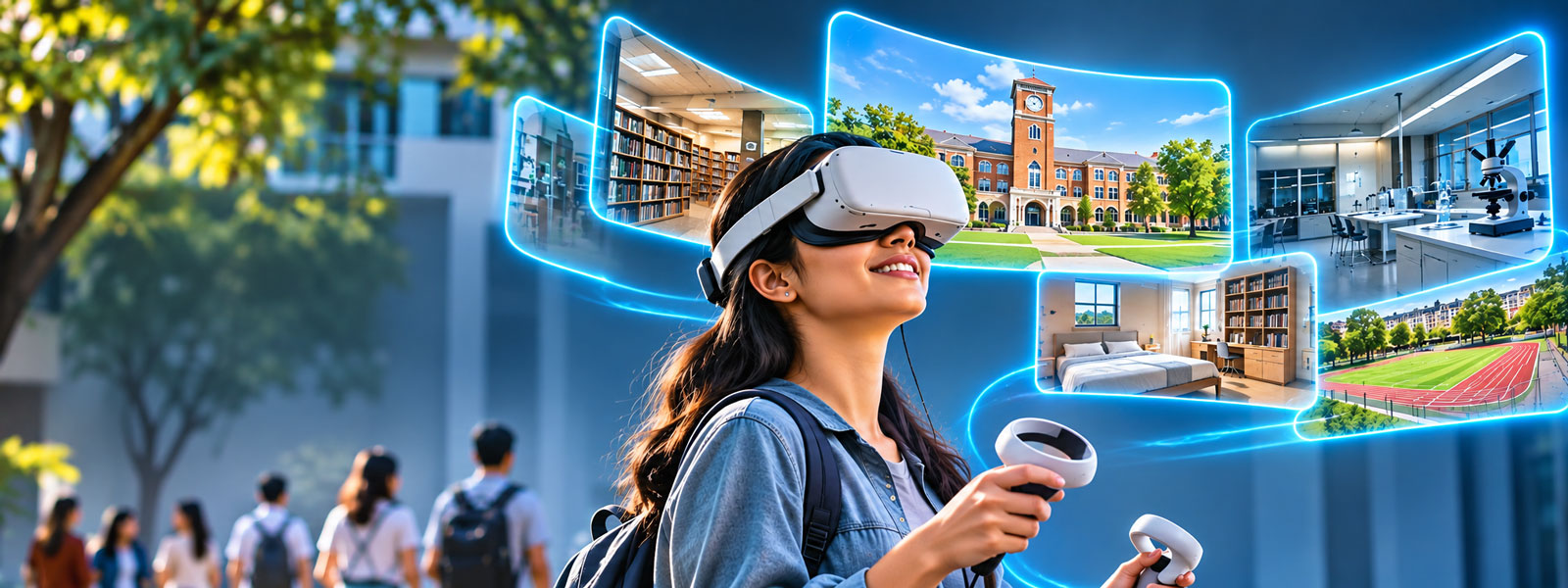
Choosing a university, college or school is not simply about selecting a course or curriculum. Students and parents are also choosing an environment — the classrooms, laboratories, libraries, hostels, sports facilities, social spaces and overall campus experience that will shape the years ahead.
But how do you communicate an entire campus through a brochure, website or presentation?
Lifesize Plans brings the campus to the audience.
Through immersive visualisation and experiential technologies, educational institutions can transform the way prospective students, parents, stakeholders and even existing students experience their campuses.
Experience the Campus Before the First Day
A conventional campus tour requires the student to physically visit the institution. For students considering universities across different cities, states or countries, that may not always be possible.
An immersive campus experience creates another possibility.
Students and parents can virtually move through key areas of the institution — entering the academic blocks, exploring laboratories, seeing the library, understanding hostel facilities, walking through sports infrastructure and experiencing important campus spaces.
Instead of being told what the campus offers, they can experience how it feels to be there.
For universities and colleges competing for students nationally and internationally, this can become a powerful extension of admissions and student engagement.
Turn the Admission Centre into an Experience Centre
Admissions are often the first physical interaction a family has with an institution.
Lifesize Plans can help transform that interaction from a conventional presentation into an immersive campus introduction.
Imagine prospective students entering an experience room where the walls, floor and surrounding environment become the campus.
One moment, they are standing inside a state-of-the-art laboratory. The next, they are exploring the hostel, moving through the library or entering the sports complex.
Large campuses can be understood in minutes without requiring visitors to physically walk across every building.
For institutions with multiple campuses, the same environment could also introduce visitors to locations hundreds or thousands of kilometres away.
Showcase Campuses That Are Still Being Built
The opportunity becomes even more valuable for new universities, campus expansions and infrastructure projects.
A proposed academic block may currently exist only as an architectural visualisation. A future laboratory may still be under construction. A new hostel, auditorium or sports facility may be months away from completion.
Lifesize Plans can turn these future environments into experiences today.
Students, parents, management teams, investors and other stakeholders can step inside proposed facilities and develop a much clearer understanding of scale, spatial relationships and the overall vision.
The future campus no longer has to remain something audiences are asked to imagine.
They can experience it before it is built.
Make the Campus Model Come Alive
Many institutions already use architectural scale models to showcase their campus.
Projection mapping can take that model further.
Buildings, departments, roads, sports facilities, hostels and future development zones can be highlighted dynamically across a physical miniature model.
Instead of looking at a static representation, visitors could watch the institution tell its own story.
Where are the engineering laboratories?
What does the residential zone include?
Where will the next phase of campus development happen?
How has the campus expanded over the years?
The model becomes an interactive visual communication platform rather than simply a display.
Bring Institutional Legacy into the Campus Experience
For established schools, colleges and universities, a campus represents more than infrastructure. It carries decades — sometimes centuries — of history.
Founding stories, archival photographs, distinguished alumni, academic milestones, cultural traditions, achievements and the evolution of the campus can become part of an immersive institutional journey.
Visitors could move from the institution’s earliest years to its present-day campus and then into its vision for the future.
Rather than displaying legacy only through photographs and timelines, institutions can create an experience around it.
Turn Four Walls into a Learning Environment
The application of immersive technology does not have to end with admissions.
It can extend directly into education.
An immersive room can transform depending on what is being taught.
A history class could enter another period.
Geography students could experience landscapes and environments at scale.
Architecture students could walk through spatial concepts.
Engineering students could explore large systems and structures visually.
Science concepts that are difficult to understand on a conventional screen could surround the learner.
The room remains the same.
The world inside it changes with the lesson.
This creates an opportunity for institutions to build dedicated immersive learning environments that complement classrooms, laboratories and conventional digital learning.
One Campus. Multiple Applications.
For universities, colleges and schools, immersive technology can support the complete institutional experience — from the first introduction to the campus to learning within it.
It can become part of admissions and student recruitment, virtual campus touring, international student engagement, new campus presentations, infrastructure showcases, immersive classrooms, institutional legacy experiences, alumni engagement and stakeholder presentations.
The technology serves different objectives, but the fundamental idea remains the same:
People understand an environment differently when they can experience it for themselves.
From Showing a Campus to Experiencing One
The next generation of educational institutions will not only communicate through websites, brochures, films and presentations.
They can create environments people can step into.
A prospective student can experience the campus before applying.
A parent can understand the facilities without travelling across the institution.
A stakeholder can walk through infrastructure that has not yet been constructed.
A student can enter an immersive environment and experience the subject being taught.
For universities, colleges and schools, the campus itself can become a story — one that can be explored, experienced and remembered.
With Lifesize Plans, you don’t just show them the campus.
You let them step inside it.